Camping has evolved beyond roughing it in the wilderness; for many, it’s about embracing comfort and convenience amidst nature’s beauty. That’s where the humble yet mighty Camping Electric Kettle steps in, transforming your outdoor experience from basic to brilliant. Imagine waking up to a steaming cup of coffee or enjoying a hot bowl of instant noodles under a starlit sky, all with the simple press of a button. A camping electric kettle is no longer a luxury but a game-changer for car campers, van lifers, and anyone seeking a touch of home comfort on their adventures.
The Evolution of the Portable Hot Water Solution
Electric kettles for camping are a natural progression from their traditional stovetop counterparts. As technology has advanced and outdoor power solutions like portable power stations have become more accessible, the design and functionality of these kettles have adapted significantly. They’ve shed bulk, embraced efficiency, and incorporated features specifically tailored for the rigors and unique power demands of the great outdoors. This evolution means today’s camping electric kettles are more versatile, safer, and more convenient than ever, ready to deliver hot water wherever your journey takes you.
Types of Camping Electric Kettles for Every Adventure
The world of camping electric kettles is diverse, with options to suit various camping styles and needs.
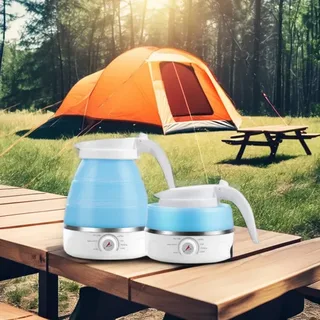
Compact & Mini Electric Kettles
These are essentially smaller versions of your home electric kettle, designed for personal use or small groups. They typically feature a sturdy build, often stainless steel, and capacities ranging from 0.5 to 1 liter. Their traditional shape offers reliable performance and heat retention.
Collapsible Electric Kettles
Space is a premium when camping, and collapsible electric kettles are masters of efficient packing. Made from food-grade silicone with a stainless steel base, these kettles compress down to a fraction of their boiling size, making them incredibly easy to store in tight spaces in a campervan or backpack.
12V Car Kettles
Designed specifically for vehicle use, 12V kettles plug directly into your car’s cigarette lighter socket. They operate at a lower wattage (typically around 150-300W), meaning they boil water slower than standard kettles but are perfect for on-the-go hot drinks during road trips without needing an inverter or power station.
Portable Power Station Compatible Kettles
Many camping electric kettles are designed to work seamlessly with portable power stations (like those from Jackery or Bluetti). These kettles often have wattages between 500W and 1500W, offering faster boil times than 12V models but requiring a more robust external power source.
How Camping Electric Kettles Work & Key Technologies
At their core, electric kettles convert electrical energy into heat to boil water. The efficiency and speed of this process depend on several factors:
- Heating Element: Most modern electric kettles feature a concealed heating element, usually a flat plate at the bottom of the kettle. This design prevents mineral buildup on the element, making cleaning easier and extending the kettle’s lifespan. Exposed coil designs are less common now, especially for portable versions where direct contact with the coil can be a safety concern.
- Power Consumption (Wattage & Voltage): This is crucial for camping. Standard home kettles can draw 2000-3000W at 220-240V, or 1000-1500W at 110-120V. Camping-specific models often have lower wattages (e.g., 500-750W) to be compatible with campsite hookups that might have restricted amperage (e.g., 5A or 10A) or portable power stations. Low-wattage kettles prevent tripping circuit breakers at campsites.
- Boil Time: A higher wattage generally translates to a faster boil time. While a 1500W kettle might boil water in 3-5 minutes, a 750W camping kettle could take around 7 minutes for a similar volume. 12V car kettles will be even slower due to their much lower wattage.
- Temperature Control: Advanced camping electric kettles offer variable temperature settings, allowing you to heat water to specific temperatures for different beverages like green tea (80°C/175°F), coffee (90°C/195°F), or boiling for instant meals. Some even have a “keep warm” function.
Choosing the Right Camping Electric Kettle: Essential Factors
Selecting the perfect camping electric kettle involves balancing your power access, group size, and specific needs.
Power Source & Wattage
This is arguably the most critical factor.
- 12V DC Input: If your primary power source is your car’s cigarette lighter, you’ll need a dedicated 12V kettle (or 24V for larger trucks). Be aware these are low wattage and will boil slowly.
- Standard AC (120V/240V) via Inverter or Power Station: For faster boiling, you’ll need a kettle with a higher wattage (e.g., 500-1500W) and a suitable power source. A portable power station (like a Jackery Explorer 1000 Plus or 2000 Plus) or a car power inverter can supply the necessary AC power. Ensure your power source can handle the kettle’s wattage. A typical camping electric kettle in the UK consumes about 750 watts, significantly less than a home kettle to prevent overloading campsite electrical systems.
Capacity
- For solo campers or couples: A capacity between 0.5 to 1 liter (around 2-4 cups) is usually sufficient and more portable.
- For families or groups: Look for kettles with a capacity of 1.5 to 2 liters to avoid frequent refills and reboiling.
Material & Durability
- Stainless Steel: Highly durable, rust-resistant, easy to clean, and excellent at heat preservation. Food-grade 304 stainless steel is a top choice, ensuring no leaching of chemicals into your water.
- Silicone: Primarily used for collapsible kettles. Ensure it’s food-grade, BPA-free silicone that can withstand high temperatures without deforming.
- Plastic: Less common for heating surfaces in quality camping kett, but exterior plastic components should be high-quality and heat-resistant.
- Environmental Adaptability: Look for dustproof and waterproof designs to enhance durability in outdoor environments.
Portability & Size
A good camping electric kettle should be compact and lightweight.
- Weight: Aim for 1-2 lbs (0.45-0.9 kg) for easy packing.
- Design: Collapsible models are ideal for saving space. Consider detachable power cords and integrated cord storage for neat packing.
Safety Features
Non-negotiable for any electric appliance, especially in a camping setting.
- Automatic Shut-off: The kettle turns off automatically once the water reaches boiling point.
- Boil-Dry Protection: Prevents the kettle from operating if there’s insufficient or no water inside, safeguarding the heating element and preventing hazards.
- Cool-Touch Exterior: While not all kettles have this, it’s a desirable feature for preventing accidental burns, particularly with stainless steel models that can get very hot.
- Comfortable, Scald-Proof Handle: Essential for safe pouring.
Convenience
- Cordless Design: Kettles that lift off their power base are much easier to handle and pour.
- Easy to Clean: Wide openings and concealed heating elements make cleaning much simpler.
- Indicator Light: A simple light that shows when the kettle is on and heating.
- Dual Voltage: For international travelers, a dual-voltage kettle (110-120V and 220-240V) is indispensable, though you’ll still need appropriate plug adapters.
Using and Maintaining Your Camping Electric Kettle
Getting the most out of your camping electric kettle involves proper usage and diligent maintenance.
Proper Filling
Always fill the kettle between the minimum and maximum fill lines. Overfilling can lead to boiling water overflowing, creating a safety hazard and potentially damaging the heating element. Filling below the minimum can trigger boil-dry protection.
Powering Options
- Campsite Hookups: Verify the amperage limit of your campsite’s electrical hookup (e.g., 5A, 10A, 16A) and ensure your kettle’s wattage doesn’t exceed it. (Watts = Volts x Amps).
- Portable Power Stations: Connect your kettle to the AC output of a portable power station. Check the power station’s continuous output wattage and battery capacity to ensure it can run your kettle for the desired duration. Jackery Portable Power Stations, for example, are known for their lightweight design and ability to power 99% of appliances, including camping kettles.
- Car Power Inverters: If using a car battery, a power inverter converts 12V DC to 120V/240V AC. Ensure the inverter’s wattage capacity matches or exceeds your kettle’s requirement.
Cleaning and Descaling
Regular cleaning is vital to prevent limescale buildup, which can affect heating efficiency and taste.
- Daily Wipe-down: Wipe the interior and exterior with a damp cloth after each use.
- Descaling: Every few weeks or months, depending on water hardness, descale your kettle using a vinegar-water solution (equal parts) or a commercial descaler. Let it sit, boil, then rinse thoroughly.
Storage Tips
Store your kettle in a cool, dry place. For collapsible models, ensure they are thoroughly dry before collapsing and storing to prevent mold or odors.
Electric Kettles vs. Traditional Camping Stovetop Kettles
While stovetop kettles have their place, electric kettles offer distinct advantages for certain camping styles.
Pros of Electric Kettles:
- Convenience: Just plug in and press a button. No need for gas canisters, fire starters, or managing flames.
- Safety: Built-in auto shut-off and boil-dry protection reduce risks, especially when used inside tents, campervans, or during adverse weather. No open flames or carbon monoxide concerns when used indoors.
- Precision: Many electric models offer temperature control, perfect for different teas or specialized coffee brewing.
- Cleanliness: No soot or grime from gas flames, keeping your kettle and cooking area cleaner.
Cons of Electric Kettles:
- Power Dependency: Requires an electrical source, which might not always be available in remote backcountry camping.
- Boil Time: Lower wattage camping models can be slower than a powerful gas stove.
- Weight & Bulk: Even portable electric kettles can be heavier and bulkier than ultralight titanium stovetop kettles.
Benefits and Applications in Daily Camping Life
A camping electric kettle quickly becomes an indispensable part of your outdoor kit:
- Hot Beverages: Instantly make your morning coffee, tea, or hot chocolate, providing a comforting start or end to your day.
- Instant Meals: Perfect for rehydrating freeze-dried meals, cooking instant noodles, oatmeal, or preparing couscous.
- Sanitation: Boil water to sterilize baby bottles, camping utensils, or to safely clean minor wounds.
- Warm Water for Washing: Heat water for washing dishes or personal hygiene, making chores more bearable in colder weather.
“A good camping electric kettle isn’t just about boiling water; it’s about bringing a slice of home comfort and efficiency to the great outdoors. It truly elevates the experience,” says veteran camper and outdoor gear reviewer, Amelia Thorne.
Frequently Asked Questions (FAQs)
Can I use a regular electric kettle for camping?
While technically possible with an adequate power source, regular household kettles often have high wattages (2000W+) that can overload campsite electrical hookups or quickly drain portable power stations. Dedicated camping electric kettles are designed with lower wattages for compatibility and efficiency in outdoor settings.
How much power does a camping electric kettle use?
Camping electric kettles typically consume between 150W (for 12V car models) and 1500W (for portable power station compatible models). A common wattage for campsite-friendly kettles is around 750W.
Are collapsible electric kettles safe?
Yes, reputable collapsible electric kettles are safe if they are made with food-grade silicone, a stainless steel heating plate, and include standard safety features like auto shut-off and boil-dry protection. Always check product specifications and certifications.
What’s the best capacity for solo camping?
For solo campers, a kettle with a capacity of 0.5 to 1 liter (around 2-4 cups) is generally ideal. It’s compact, lightweight, and sufficient for one or two servings of hot water.
Can I boil eggs in a travel kettle?
You can boil eggs in a travel electric kettle, provided it has a flat, concealed heating element at the bottom (not exposed coils) and sufficient capacity. Just add water and eggs, and boil as usual.
Conclusion
The camping electric kettle has carved out a vital niche in the world of outdoor equipment, bridging the gap between rugged adventure and modern convenience. From quick morning brews in your campervan to rehydrating meals on a remote car camping trip, these compact powerhouses offer unparalleled ease and safety. By considering factors like wattage, capacity, material, and essential safety features, you can choose a camping electric kettle that not only fits your adventurous lifestyle but also enhances every outdoor moment. Invest wisely, and you’ll unlock a world of hot, comforting possibilities wherever your journey takes you.